How Much Does A Business Website Cost In London?
A practical guide to London website costs, realistic investment levels, the factors that change a quote and how to choose a budget that supports growth.

Website prices can seem frustratingly inconsistent. One provider might quote £1,500 while another recommends an investment of £15,000 for what appears to be the same number of pages.
The difference is rarely just the design. It usually comes down to the strategy, content, functionality, experience and level of commercial thinking included in the project.
This guide explains the typical investment levels for a business website in London, what changes the final price and how to decide which budget is appropriate for your next stage of growth.
The short answer
A professional London business website can cost anywhere from approximately £1,500 to £40,000 or more.
That range is not especially useful until you understand what is being purchased. A simple template-led website and a growth-focused website may contain the same number of pages, but they solve very different problems.
For many established small businesses, a sensible bespoke website design project sits around £4,000–£12,000. This normally creates enough room for positioning, page planning, purposeful copy, custom design, a high-quality build, search foundations and meaningful measurement.
This is a general market guide rather than a Lazaro London quotation. The right investment will depend on what your website needs to accomplish.
Four common website investment levels
These ranges explain the type of input and outcome you should expect. VAT, platform subscriptions, specialist integrations and ongoing marketing may be additional.
1. DIY or template website
Typical investment: £200–£1,500
This level is suitable when the offer is simple, the budget is limited and you can provide the strategy, writing, imagery and setup time yourself.
It will commonly include:
- An existing template or website-builder theme
- Limited page and design variation
- Client-supplied copy and imagery
- A basic contact form
- Basic page titles and metadata
- Minimal strategic or conversion input
A template can be a sensible starting point for a new business. The main risk is the hidden cost of your own time and a structure that becomes restrictive as the business develops.
2. Focused professional website
Typical investment: £1,500–£4,000
This level is suitable for a straightforward local service business that needs a polished, credible website with a clear offer and a manageable number of pages.
It will commonly include:
- Light discovery and page planning
- A customised design system
- Approximately five to eight focused pages
- Responsive development
- Basic SEO implementation
- Contact forms and analytics
- Some guidance around content
Before accepting a quote, confirm what you are expected to provide. Copywriting, positioning, photography and content migration may sit outside the stated price.
3. Growth-focused business website
Typical investment: £4,000–£12,000
This level is suitable when the website must explain a valuable offer, support search growth and convert qualified visitors into enquiries.
It will commonly include:
- Positioning and conversion strategy
- Customer and competitor research
- Complete information architecture
- Purposeful page copy
- Bespoke responsive design
- Flexible CMS development
- Analytics and conversion measurement
- Technical and on-page SEO foundations
- Launch planning and training
This is often the most appropriate level for an established service business whose website needs to contribute directly to customer acquisition.
A growth-focused website redesign should improve the positioning, visibility and customer journey—not simply replace the existing visual style.
4. Complex or specialist website
Typical investment: £12,000–£40,000+
This level is suitable for complex content, multiple audiences, ecommerce, bespoke tools, significant integrations or a larger stakeholder process.
It may include:
- Detailed audience research and UX work
- Multiple page templates and content systems
- Advanced functionality
- CRM, booking or payment integrations
- Ecommerce or membership functionality
- Extensive content migration
- Formal testing and governance
- Multiple stakeholder workshops
- Ongoing optimisation support
-
The main risk for a smaller business is paying for organisational complexity it does not need. A good provider should reduce unnecessary scope as confidently as they recommend further investment.
What actually changes the price?
The useful question is not “How much does a page cost?”
The better question is: Which decisions and work are required for this website to achieve its purpose?
Strategy
Customer research, positioning, offer structure and conversion planning require senior thinking before design or development begins.
A website that must create demand or support a premium service will generally require more strategic work than one that simply confirms the business exists.
Copywriting
Writing complete, persuasive content is a separate discipline from placing client-supplied text into a design.
Good website copy must explain the offer, differentiate the business, address objections, present evidence and guide visitors towards a clear next step.
Page types
Ten repeated article pages are simpler to design and build than ten individual service, comparison, case-study and conversion pages.
The number of unique templates matters more than the total number of URLs.
Design depth
A well-established identity costs less to translate into a website than a project that must also define the visual language, typography, imagery and creative direction.
Bespoke interaction and animation can add value, but only when they support the message and experience.
CMS complexity
Services, locations, team members, insights, testimonials and case studies need thoughtful relationships and editing rules.
The objective should be a CMS your team can use confidently—not the largest possible collection of fields.
Integrations
Booking systems, CRM platforms, memberships, payments, email automation and custom data requirements increase setup and testing time.
Even apparently simple integrations can require decisions about permissions, error handling and customer data.
Migration
An established website needs content decisions, redirect mapping and search protection that a new domain does not.
A careful migration should preserve useful URLs, metadata, internal links and existing search value.
Specialist industry requirements
Different industries introduce different content and conversion requirements.
For example, a travel website may need destination content, trust credentials and a more detailed enquiry journey. A local service company may place greater emphasis on locations, reviews and high-intent search pages.
Stakeholders
More decision-makers can provide valuable input, but they also increase workshops, feedback rounds and project management.
A clear approval process helps prevent conflicting feedback and unnecessary delays.
What should be included in a growth-focused quote?
A detailed proposal should make it possible to see who is responsible for every important part of the result.
Look for the following:
- Discovery: Business objectives, audiences, priorities and success measures
- Structure: Sitemap, page roles and important customer journeys
- Content: Who writes, edits and approves the copy
- Proof: Who supplies testimonials, results, credentials and case studies
- Imagery: Whether photography, image sourcing or art direction is included
- Design: Responsive layouts, reusable components and feedback stages
- Development: CMS setup, forms, integrations and browser testing
- SEO: Metadata, headings, redirects, canonicals, internal links and sitemap
- Measurement: Analytics and meaningful conversion events
- Handover: Training, ownership, warranty period and future support
If an important responsibility is not mentioned, ask whether it is included before comparing the final prices.
Ongoing website costs to budget for
The initial website invoice is rarely the complete cost of ownership.
Your provider should explain which costs are paid directly to platforms and which cover active professional support.
Domain name
Typical cost: approximately £10–£30 per year
The cost varies according to the domain extension and registrar. Premium domains can cost considerably more.
Hosting or website plan
Typical cost: approximately £15–£60 per month
This is a common range for a professional brochure or CMS website. Ecommerce, localisation and enterprise requirements can increase it.
Website support and improvements
Typical cost: approximately £150–£1,500+ per month
The cost depends on the capacity, response expectations and services included.
Basic support might cover occasional content changes and technical fixes. A more active website support programme might include new landing pages, conversion improvements, analytics reviews and continuous development.
Content and search growth
Cost: dependent on scope
New service pages, useful articles, photography, video, digital PR and local SEO should have their own growth plan.
Publishing more content is not automatically valuable. Each page should address a real customer question, search intent or commercial opportunity.
Cheap, expensive and good value are not the same thing
A £1,000 website that accurately explains a simple offer and wins customers can represent excellent value.
A £15,000 website that attracts praise but creates no commercial clarity can represent poor value.
Value depends on whether the investment solves the business constraint.
If the primary problem is weak positioning, buying more animation will not solve it. If the business already attracts visitors but loses them at the enquiry stage, conversion work may matter more than publishing another twenty articles.
Do not ask only, “What will the website cost?” Ask, “What must this website make clearer, easier or more valuable for the business?”
How to choose a sensible website budget
1. Define the commercial job
Decide whether the website must create credibility, support referrals, generate enquiries, enable transactions or open a new market.
A website expected to contribute directly to revenue needs a different level of planning from one intended only to confirm the business exists.
2. Prioritise the audiences and offers
A focused first version for one valuable customer group is often stronger than a broad website that speaks vaguely to everyone.
Identify which services, sectors and customer problems deserve dedicated pages.
3. List capabilities rather than decoration
Document the CMS requirements, booking process, integrations, proof, search pages and measurement needs before discussing visual features.
This keeps the budget focused on what the website must enable.
4. Separate launch from growth
Decide what must exist on the first day and what can be published or improved during the following three to six months.
A smaller, strategically complete launch is usually stronger than delaying the project to include every possible future feature.
5. Compare responsibilities
Check whether each quote includes strategy, writing, imagery, migration, SEO, analytics and post-launch support.
Two proposals with the same page count may place very different responsibilities on your internal team.
6. Consider the value of the result
Estimate what a stronger website could realistically contribute.
For a business where one new customer is worth several thousand pounds, improving trust and generating a small number of additional enquiries may justify a more substantial investment.
Avoid unrealistic revenue predictions, but do compare the project cost with the commercial value of solving the underlying problem.
Questions to ask before choosing a website provider
Ask potential providers:
- What business problem will the proposed scope solve?
- Who is responsible for the copy and proof?
- Which pages are bespoke and which reuse a template?
- How will the existing search visibility be protected?
- What will our team be able to update?
- How will enquiries and other conversions be measured?
- Which platform and ongoing subscriptions are required?
- What is not included in the quoted price?
- What happens during the first 90 days after launch?
- Who will actually complete the strategy, design and development work?
- How will feedback and approvals be managed?
- What support is available after launch?
The answers should make the process and responsibilities clearer—not introduce more ambiguity.
Frequently asked questions
Why do London website quotes vary so much?
Two quotes can describe “a five-page website” while including completely different levels of strategy, copywriting, design, development, migration and measurement.
Page count alone is therefore a poor way to compare value. Ask each provider to explain the decisions, responsibilities and deliverables included.
Should a small business publish its website budget?
Sharing a realistic range helps a good provider recommend an appropriate scope quickly.
It should not mean automatically spending the maximum. Ask what would be prioritised at different investment levels and which elements could be introduced later.
Is Webflow more expensive than WordPress?
The build cost depends more on the project scope and provider than the platform name.
Webflow commonly reduces plugin and server maintenance, while WordPress offers a wider plugin ecosystem. Compare design flexibility, total ownership, maintenance requirements and who will manage the website—not only the initial invoice.
How much should ongoing website support cost?
Light content support may cost a few hundred pounds per month, while regular design, development, SEO and conversion work can run into four figures.
Compare the available capacity, response expectations and commercial outcomes rather than choosing a support plan purely by hours.
Can a cheap website still work?
Yes. A lower-cost website can work when the offer is simple, the template fits and the business can provide strong content.
The risk begins when a low-cost build is expected to solve positioning, search strategy, content, conversion and complex functionality without the time those decisions require.
How long does a professional website take to create?
A focused small-business website commonly takes several weeks. A larger strategic website may take a few months.
Content readiness, stakeholder availability, integrations, migration requirements and feedback speed usually influence the schedule more than the raw number of pages.
Should SEO be included in the website price?
The technical and on-page foundations should normally be included. These cover areas such as headings, metadata, indexation, responsive performance, internal linking and redirects.
Ongoing keyword research, content development, link acquisition and search optimisation are usually separate services because they continue after launch.
The bottom line
Buy the website your growth plan requires—not the largest website someone can sell you.
A good partner should be able to reduce unnecessary scope as confidently as they recommend investment.
Start with the customer journey and the commercial result. Then choose the simplest strategy, content and technical system capable of delivering it.
Key Takeaway
For many established small businesses, a growth-focused bespoke website typically sits around £4,000–£12,000. The right budget depends on the commercial job, strategy, content, complexity and support required.
Related Work
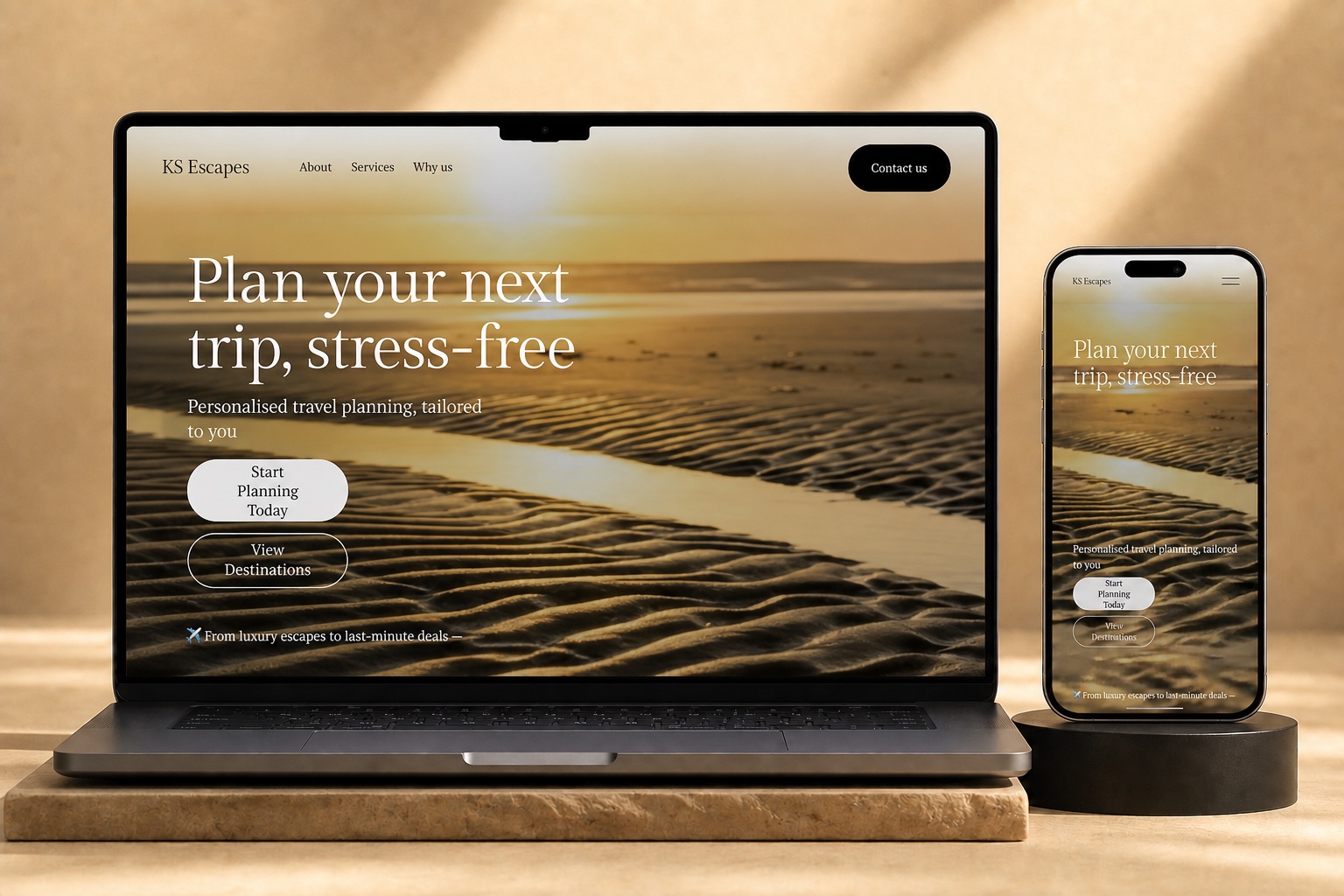
A calm, trust-led travel website that turns an independent planning service into a clear, credible route from holiday inspiration to enquiry.