How Web Design and SEO Work Together to Grow a Service Business
A practical guide to building a website where design, structure and SEO reinforce each other—helping the right people find the business, trust it and take action.
A good website has two jobs.
It needs to help the right people find the business, and it needs to convince those people that the business is worth contacting.
SEO is often treated as responsible for the first job and web design for the second. In reality, the strongest websites do not separate them so neatly.
The structure of the website affects what it can rank for. The content affects what visitors understand. The design determines what receives attention. Internal links connect related ideas. Calls to action turn that attention into something commercially useful.
When these pieces are planned together, the website becomes more than a collection of attractive pages. It becomes a system for creating visibility, building confidence and generating opportunities.
SEO should influence the website before it is designed
SEO is sometimes introduced at the end of a website design project.
The pages have already been decided. The layouts have been designed. The copy is nearly complete. Then somebody is asked to “optimise it for Google”.
That approach limits what SEO can actually contribute.
Before designing individual pages, the business should understand what customers are searching for and which of those searches deserve their own destination.
A growing service business might need separate pages for:
- its core services;
- important specialist services;
- commercially relevant locations;
- industries it serves;
- case studies;
- useful informational content.
That does not mean creating a page for every keyword variation.
It means giving genuinely different customer intentions a clear place within the website.
A strong web design process should therefore consider search demand, customer journeys and page responsibilities alongside visual direction.
One important page should have one clear job
A common problem on smaller business websites is trying to make one page rank for everything.
A single services page might briefly mention web design, SEO, branding, maintenance and several locations. It technically contains all of the right words, but none of those subjects is explored with enough depth to become particularly useful.
The alternative is a clearer information architecture.
A broad Services page can introduce the complete offer. Dedicated service pages can then explain individual problems and solutions properly. Supporting Insights can answer the questions customers ask before they are ready to enquire.
Each page becomes responsible for a particular stage of the journey.
For example, somebody searching for information about how SEO works has a different immediate need from somebody actively comparing SEO services in London.
The first visitor may need education.
The second needs to understand the service, approach, evidence and next step.
Creating separate content for those intentions makes the website easier to understand for both visitors and search engines.
Design determines what happens after somebody arrives
Ranking is not the final objective.
A page can attract search impressions and clicks while still doing very little for the business.
Once somebody lands on the website, design begins doing a different job.
The page needs to establish context quickly:
What does this business do?
Is this relevant to me?
Why should I trust it?
What should I do next?
Visual hierarchy helps answer those questions in the right order.
The headline introduces the core idea. Supporting copy provides context. Proof reduces uncertainty. Service information explains the solution. Calls to action make the next step obvious.
Good design is therefore not separate from search performance in the commercial sense. Search can create the opportunity, but the experience after the click determines whether that opportunity develops.
Content should support service pages rather than compete with them
Publishing Insights can help a website expand its useful coverage, but more content is not automatically better.
The important question is what role each piece plays.
A commercial service page should focus on someone considering that service.
An Insight should normally explore a related question in more depth.
For example, a website redesign page can explain the redesign service itself: who it is for, what problems it solves, what is included and how the process works.
Supporting Insights can address questions around it:
How do you know when a website needs redesigning?
What happens to SEO during a redesign?
How much does a website redesign cost?
Should an existing website be improved or completely rebuilt?
The articles capture related informational intent while strengthening the subject around the main service.
They should then naturally guide relevant readers towards the service page when they reach the point where professional help becomes useful.
This creates a content ecosystem instead of a collection of disconnected blog posts.
Internal links connect that ecosystem
A website can contain excellent individual pages and still feel fragmented if they are not connected properly.
Internal links show readers where useful related information lives.
An Insight discussing website structure may naturally point towards an SEO service.
An article about an ageing site might lead into website redesign.
A piece discussing geographical search visibility might introduce local SEO.
A finished project could link to the relevant case study, while that case study can point back towards the service responsible for the outcome.
The wording of those links matters too.
Descriptive phrases such as “website redesign”, “local SEO” or “ongoing website support” provide more context than repeatedly using vague phrases such as “click here”.
The objective is not to force as many links as possible into every page.
A link should exist because the destination genuinely helps the reader continue their journey.
Web design creates the framework SEO grows into
A website does not need hundreds of pages when it launches.
It does need a structure capable of supporting new ones.
That means designing navigation, CMS collections, reusable sections and page relationships with future growth in mind.
A business might initially launch with its core services and a small number of Insights. Search data can then reveal which subjects are gaining impressions and which questions deserve deeper coverage.
New pages can be introduced deliberately.
A useful Insight may support an existing service.
A location page may address meaningful local demand.
A case study may provide proof for a claim already being made elsewhere.
A new service page may become appropriate when the business develops a distinct offer that deserves its own search and conversion journey.
This is where web support can move beyond fixing technical problems. Ongoing improvements allow the site to evolve alongside real customer behaviour, search data and business priorities.
The result is a website that was built to grow rather than one that gradually becomes harder to manage as more content is added.
Website redesigns need both disciplines even more
The relationship between SEO and design becomes particularly important during a redesign.
An established website may already have pages attracting impressions, backlinks, direct visits or referrals.
Replacing the site without understanding what currently has value can remove useful content or break existing routes into the business.
A strategic redesign should therefore begin with evidence.
Which pages already attract search visibility?
Which URLs should remain?
Which content should be improved?
Where are multiple pages competing unnecessarily?
Where is important customer intent missing entirely?
Which journeys fail to turn visitors into enquiries?
The new design can then improve the experience while preserving and strengthening the useful foundations underneath it.
A redesign should not simply make the website newer.
It should leave the business with a clearer structure, stronger content, better conversion journeys and a better platform for future search growth.
Local SEO also depends on the website
Local visibility is sometimes treated as something that happens entirely inside a Google Business Profile.
The website still has an important supporting role.
A business serving multiple areas may need clear information about where it works. Its service pages need to explain what it actually provides. Location-specific pages can be useful when there is enough genuine relevance to justify them.
The important distinction is between creating useful local content and producing dozens of near-identical pages with different place names.
A strong local SEO structure connects the service, location and customer problem.
The page should exist because somebody searching in that area would genuinely benefit from reaching it.
That makes local growth part of the wider website architecture instead of a separate tactic bolted onto the side.
What a connected website growth system looks like
When web design and SEO work together, the process becomes cyclical.
Search demand helps identify what customers care about.
That information shapes the site architecture.
The architecture gives each important topic an appropriate page.
Design makes those pages understandable and convincing.
Internal links connect related journeys.
Analytics and Search Console reveal what begins gaining traction.
Existing pages can then be strengthened and new supporting content created where the evidence justifies it.
Over time, the website becomes deeper without becoming chaotic.
Every new page has a reason to exist and a relationship with the rest of the site.
A simple way to evaluate your own website
Ask whether a potential customer can move logically through these stages:
Find
Can the website be discovered for the services, problems and locations that matter to the business?
Understand
Does each important page clearly explain what the business offers and who it is for?
Trust
Are useful details, process information, case studies, testimonials or other credible proof available at the point they matter?
Act
Is there an obvious and appropriate next step?
Continue
Can someone who is not ready yet easily explore related services, Insights or work?
Weakness at any one stage limits the entire system.
More traffic will not completely solve unclear positioning.
A beautiful interface will not help if valuable pages cannot be discovered.
Publishing more articles will not create much value if none of them support a meaningful commercial journey.
The pieces need to reinforce one another.
The takeaway
The most effective websites are not designed first and optimised later.
Search strategy helps decide what the website needs to contain. Web design turns that structure into an experience people can understand and trust. Useful content expands the site's depth. Internal links connect those pages. Ongoing measurement reveals what should improve next.
That is when a website begins behaving less like a digital brochure and more like a long-term growth system.
Key Takeaway
Web design and SEO work best as one connected system: search strategy determines what deserves visibility, design turns that visibility into trust and action, and ongoing content gives the website more opportunities to grow over time.
Related Work
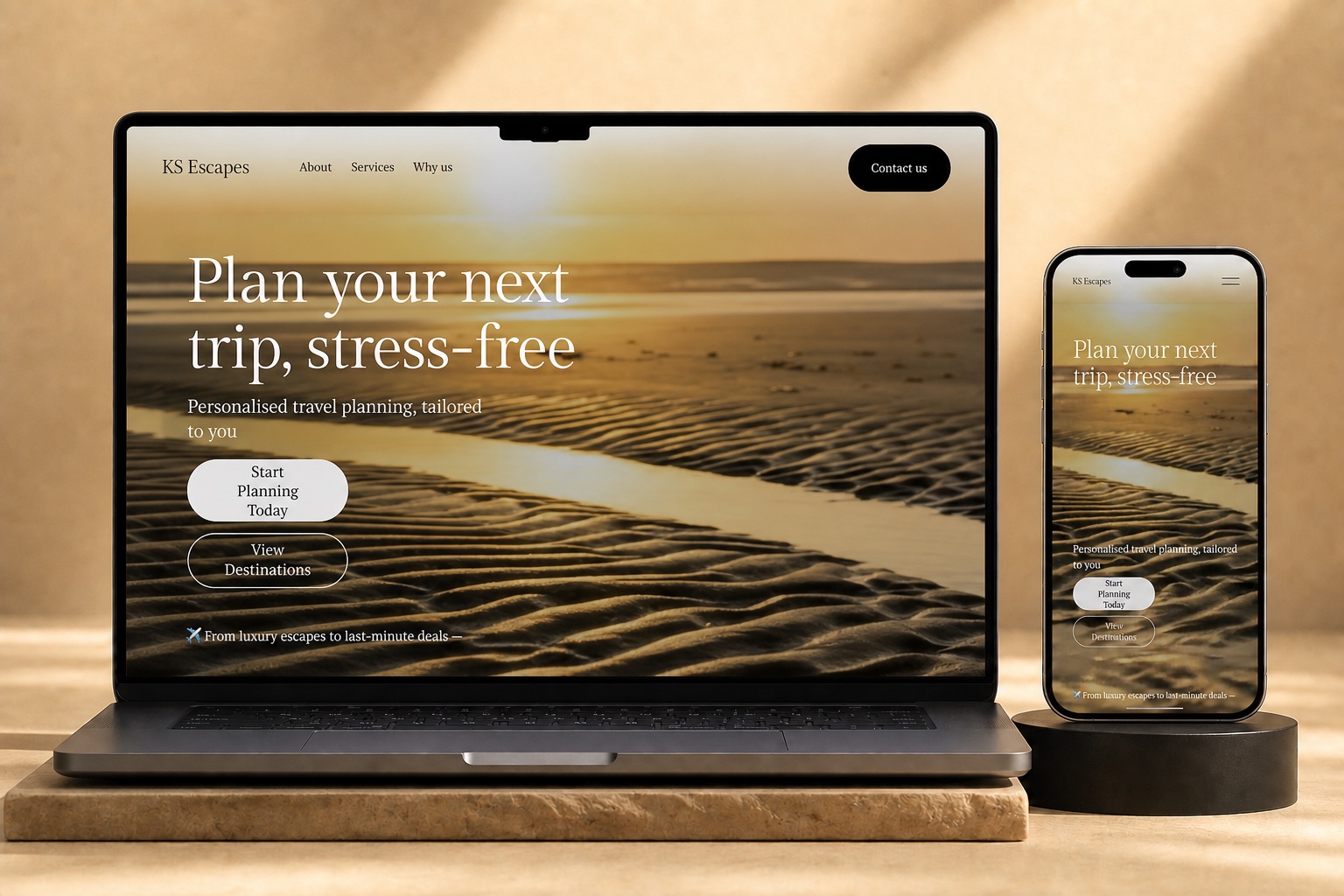
A calm, trust-led travel website that turns an independent planning service into a clear, credible route from holiday inspiration to enquiry.